.png "Return Home")
Advocacy Update 2026: Week 11

Thank you to this week’s sponsor of our Advocacy Update:

March 27, 2026
As the House finishes its work on a $9.334 billion budget, signs of the endgame and the remaining rifts are emerging. This week, we explore some of those by diving into:
- How the House budget differs from the Governor’s proposed
- public-safety-and-quality-of-life
- A preposterous and late “extreme” heat amendment that covers rather normal working conditions
- Education property tax cost containment bill passed by the Senate
- How the Education Fund is encroaching on every other fund
- There’s always more in the Laundry List
If you have any questions and want to go deeper on any of these issues, please reach out to us.
LCC Legislative Breakfast Series
Every year, we bring legislators, policymakers, and LCC members together to celebrate business ownership and entrepreneurship and advocate for economic opportunity for our region. Sponsored by EastRise Credit Union, our Legislative Breakfasts are opportunities to connect with legislators and those in higher office.
March Focus – The Regional Governance Debate: Is Vermont’s “town-by-town” structure holding us back? At LCC, we believe the biggest obstacle to solving our state’s policy problems is often the town line.
- We are actively testifying and engaging with policymakers on potential non-duplicative regional models that streamline governance without adding bureaucracy.
January Legislative Breakfast
- When: Rescheduled to April 20th!
- Where: The Nine | 1205 Airport Parkway, South Burlington
Thank you to our hosts, The Nine and Dealer.com, for their generous support of our Legislative Breakfast Series!
Thank you to our breakfast sponsor

House Budget Writers Finish Their Work; Rifts Remain
90-second read
The House budget writers, who start the budget process, have finished their work, presenting a budget worth a total of $9.334 billion, compared to the Governor’s proposed budget totaling $9.335 billion.
Distinct differences:
- Surplus buy-down: As we covered last week, the House Ways and Means Committee elected to use the existing surplus to buy down tax rates over two years instead of all in one year.
- Spending differences: The House budget spends $1 million less than the Governor’s plan, yet it spends $17.5 million more from the General Fund.
- How? To fund this difference in general fund spending, the House identified two revenue sources the Governor did not use: $9.5 million in interest accrued on a fund for state IT upgrades, and $9.4 million in revenue expected from modifying the state tax code to align with the federal “One Big, Beautiful Bill Act”.
- New positions: Scott did not propose creating any new state jobs; instead, recommending that the legislature draw from a pool of existing vacancies for new functions. The House established six new permanent state government positions and utilizes others from the vacancy pool.
- Purchase and Use Tax Reallocation back to the T-Fund: Governor Scott proposed a plan to incrementally end a $50 million annual transfer of the purchase and use tax to the education fund. As we covered last week, the House has decided to make a one-time $10 million transfer.
Homelessness and Transitional Housing: While both budgets allocate $21.2 million for the homelessness response continuum, the House budget provides a much more granular mandate for how those funds must be spent:
- $14.1 million for emergency housing in hotels and motels.
- $3 million for the development of permanent shelter.
- $1.5 million for emergency cold weather shelters.
- $2.06 million for staffing, grants, and contracts.
- $500,000 for grants to municipalities.
- Some of this is allocated through H.939, which is this year’s attempt at a grand bargain on the general assistance program, which failed last year.
Long road ahead: the budget will need to come to the House floor next week before being sent to the Senate for markup and debate.
Roadblock ahead: the budget is the only truly must-pass legislation that the general assembly considers, and the Governor has threatened not to sign the budget unless a plan to consolidate the state’s school districts is agreed upon.
More Budget Highlights
View and download the H. 951 – Fiscal Year 2027 Appropriations ActAs Introduced by the House Committee on Appropriations
“Extreme Temperature” Legislation Would Cover Rather Normal Temperatures
1-minute read
A coalition of Vermont employers has voiced significant concerns about the language proposed by the House Committee on General and Housing to add to S.230 to create an “Extreme Temperature Worker Protection Act,” which would impose prescriptive workplace regulations triggered by common Vermont weather conditions.
How bad can it be? Preposterous. The bill sets “extreme” thresholds at levels frequently reached in Vermont: above 80°F (wet bulb globe temperature) and below 35°F.
- Broad Impact: Because these temperatures are common, the bill would regulate routine daily operations rather than just hazardous extremes.
- Operational Strain: Employers would face layered obligations for monitoring, documentation, and retrofitting, with site-specific injury prevention plans. Constant updates to plans and real-time compliance tracking would require significant additional staffing and administrative capacity.
The Current Landscape: The coalition emphasizes that Vermont employers already operate under VOSHA and OSHA safety frameworks. They are urging the House General and Housing Committee to fully evaluate how existing laws address environmental hazards before adding a new layer of prescriptive requirements.
What’s next? Speak up!: S.230 is currently under consideration by the House General and Housing Committee. If you have concerns about this legislation, you should reach out to committee members.
Public Safety and Quality of Life
2-minute read
While it may not seem as if much is happening on public safety this legislative session, and much of the attention of these updates has been about the success of the accountability docket , more has been done to mitigate the challenges facing communities statewide.
- All of the bills below have now passed the chamber they were introduced in and are going to the other.
- Taken together, they could have a meaningful impact on public safety and quality of life in downtowns, making operations easier for many businesses.
- The Scott administration still sees much of this as not going far enough.
The “Forensic Facility” – S.193: This bill creates a secure facility for defendants charged with murder, sexual assault, or kidnapping who are found mentally incompetent to stand trial.
- Why it matters: It ends the “legal limbo” where violent offenders sit in standard prisons without treatment or are released into the community without supervision.
Windham County Policing Pilot – S.255: This bill, which passed the Senate and is now under consideration in the House, would establish a five-year pilot for a Regional Law Enforcement Governance Council to coordinate sheriff and municipal services in Windham County.
- Why it matters and how it works: The bill would allow towns to join by a vote of their selectboards and levy a special assessment (based on population) to fund shared dispatch, animal control, and law enforcement.
- The success of this pilot could have statewide implications for resource sharing.
The House’s Gun Bill – H.606: A massive and controversial package targeting gun theft, with three main components.
- Gun theft = felony: theft of a firearm is classified as grand larceny, regardless of the firearm’s value, as was previously the case. This particular item has long been a goal for the business community, including the Lake Champlain Chamber.
- Mental Health Restrictions: Prohibits gun possession for individuals deemed a danger to themselves or others by court order.
- Machine Gun Ban: Prohibits possession of machine guns.
Bail and the revolving door – H.409: This bill is a procedural fix rather than a total overhaul of bail laws that some had hoped to see. The bill clarifies that prosecutors can appeal a bail denial and attempts to speed up the process and create some standards by pushing these cases to the Supreme Court.
- Why it matters: A constitutional right to bail means that if a defendant is out on bail and violates their conditions, a prosecutor can ask a judge to revoke their bail; however, judges often feel their hands are tied by high legal thresholds.
Redefining Recidivism – H.410: one bright spot of consensus. It would broaden the definition to include re-arrests and shorter sentences, providing a more honest picture of crime.
- Why it matters: Vermont’s current definition of a “repeat offender” is so narrow, only counting those sentenced to 1+ years, so someone could be convicted of many crimes in one year and still not be counted in the data.
Reintegration Assistance – H.549: The bill aims to waive the $29 fee for nondriver IDs for anyone detained or sentenced for six months or more, ensuring incarcerated individuals have state-issued IDs upon release to help them secure housing and jobs.
- Why it matters: For the roughly 500 people released annually, the lack of a simple plastic card is often the primary barrier to immediate employment, fueling the cycle of recidivism.
Pretrial Supervision languishes: This program, intended to have Department of Corrections probation officers in each county monitor and keep in touch with defendants to ensure they make court dates, was made a pilot program and was found to be of less use because it ran concurrently with the “accountability docket,” rendering it superfluous.
- Additional resources for the program seem as though they will not get across the finish line.
Senate Passes Education Cost Containment Bill
90-second read
The Vermont Senate advanced S.220 on Friday, a bill designed to curb rising education costs by tightening “soft” caps on school district spending starting in 2028.
Why it matters: As Vermont grapples with skyrocketing property taxes, lawmakers are searching for some sort of cost containment mechanism that reins in spending without stripping voters of local control.
What’s being done and how it works: The bill leverages the state’s excess spending threshold, which double-taxes every dollar spent above a certain limit.
- The Change: S.220 lowers that threshold from 118% of the state average to 112% in an attempt to disincentivize districts from proposing budgets that significantly outpace the state average.
- The Sweetener: To win support, the Senate added a crucial amendment exempting voter-approved debt from the penalty.
Same, but different: LCC led a coalition that worked with the Senate President Pro Tem earlier this session to push S.220 with strict allowable growth rates. The legislation has evolved to instead have excess spending thresholds.
- The difference? Think of caps as a speed limiter on every driver’s engine, preventing speeding and excess spending thresholds, such as a photo-enforced speeding ticket.
- The issue: there is a potential speeder who treats the speeding ticket as a cost of doing business and pushes right through the pain of the extra expense.
- Instead of lowering taxes, it could simply lead to higher tax bills for districts that feel they have no choice but to spend.
Omnipresent issue – regional cost differences: the so-called “cost of competition” is a way to differentiate between the cost of labor in different regions of the state, and this becomes apparent in the conversations around both the EST and the foundation formula.
- Zoom out: the state’s Joint Fiscal Office publishes annually the Basic Needs Budget, which outlines the differences in necessary wages in the rural and urban job markets.
- Zoom in: 80% of the education spending of any district is on labor, yet the foundation formula and broader education discussions do not take the regional differences in the cost of labor into account.
Other Education News:
Over in the House, they passed H.931 this week, the miscellaneous education bill, which punts on the effective date the Vermont Agency of Education could enforce class-size minimums by one year, to July 1, 2027.
- Act 73 gave the State Board of Education the ability to close a school that failed to meet class-size minimums after three years of noncompliance.
Education Fund Encroachment on Its Neighboring Funds Escalates to Pilot Fund
2-minute read
The last two weeks have seen escalating tensions over the future of transportation funding and the use of surplus from a municipal tax fund, with far-reaching implications.
Road Rage in the LOT: This year’s transportation bill sought to use half of the surplus collected in the Payment in Lieu of Taxes Fund (PILOT) fund, which holds the state’s share (25%) of local options taxes (LOT) levied by municipalities.
- In doing so, the Transportation Committee stumbled upon a secret agreement to direct PILOT surplus to cover new reappraisal costs created by education property tax changes, upsetting many, as that activity is typically funded by the General Fund.
- Municipalities would like to see that surplus, which comes from their taxpayers, directed toward additional efforts to alleviate transportation pressures for them.
The Ed Fund is a Bad Neighbor: It is encroaching on its neighboring funds. This is the root of most of the state’s fiscal problems, and it is affecting every other fund. The general fund and transportation fund don’t have the fierce advocates that the education fund has.
- While the education fund has been repeatedly gifted with new revenue sources that only grow, such as online sales via Wayfair, the transportation fund has had the same revenue sources, and that source has been notably contracting over the last decade.
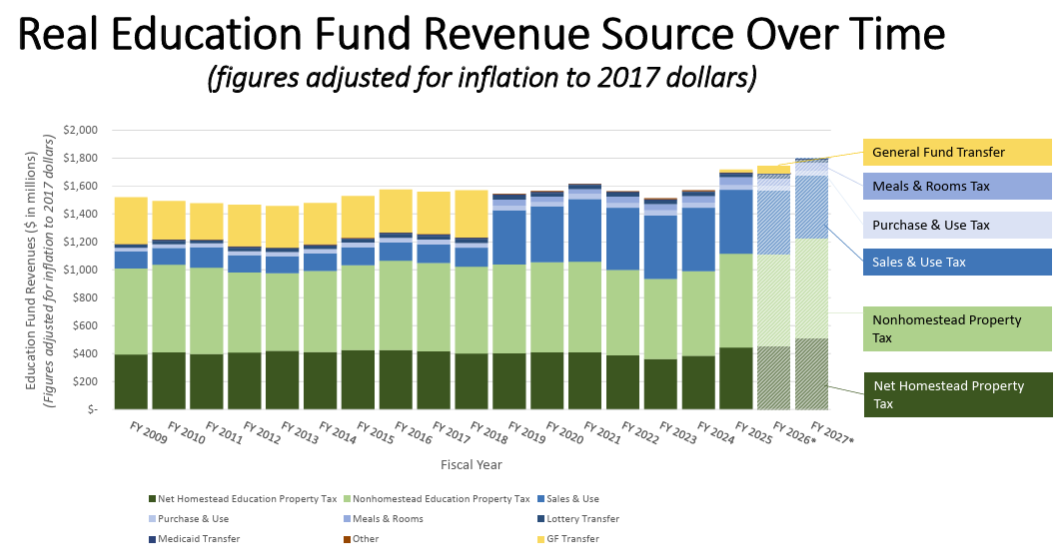
- The general fund surplus has continually been plundered to feed the education fund, as spending has grown to be among the highest in the county, and efforts at cost containment have been thwarted.
- Vermont has not fixed systemic problems in the education fund, we have only added new revenue.
The shared front yard: The neighbor often not thought of is the municipal budgets.
- We sympathize with municipalities that feel intense pressure from education property taxes, which have risen by more than 40% over the last five years, making it difficult to fund local services through traditional property tax increases.
- It’s encroaching on the yard.
Fiscal Necessities vs. Property Tax Relief: Towns are increasingly using the LOT, which is their one other opportunity to diversify funding, to fund local government operations without further increasing property taxes, with more direct authority under Act 144 to implement LOTs.
LOT Proliferation: This Town Meeting Day 2026, 13 towns joined more than 37 of their peers to implement a local option tax with more to come.
- This proliferating patchwork of local consumption taxes is not something our Chamber likes to see, as Vermonters are struggling with some of the highest tax burdens in the country.
Using municipal authority and initiative to fund state problems: Municipal leaders pitch these taxes to their constituents to resolve local issues, not to supplant state responsibilities. If there is a surplus, we’d like to see that go back to municipalities to fund municipal initiatives.
- If that is not an option to be entertained, then that funding should be directed to town highway funding, as the T-bill had proposed, to benefit those municipalities.
- We see it as imperative to ensure the transportation fund can satisfy the most basic obligations of state government, keeping the roads functioning, and we should not put federal funds in jeopardy.
- Now, instead of fixing the T-Fund itself, the Legislature will likely enlist municipalities to do the heavy lifting.
Supplanting state responsibilities: Reappraisal cost increases from Act 73 are necessary to manage the statewide grandlist for education property taxes. This expense is a general fund expenditure and should stay that way.
The Laundry List:
- Read previous updates: Week 1, Week 2, Week 3, Week 4, Week 5, Week 6, Week 7, Week 8, Week 9, and Week 10
- Penny for your thoughts? We’re looking for member feedback on H.837, a bill that aims to create a legal framework around symmetrical rounding in cash transactions in a country where pennies are going the way of the dodo. Here is how it works:
- Round Down: If the final digit of the total (after taxes and fees) is 1, 2, 6, or 7, the merchant rounds down to the nearest multiple of five.
- Round Up: If the final digit is 3, 4, 8, or 9, the merchant rounds up.
- Let us know what you think at advocacy@vermont.org.
- Act 250 and Act 181 changes were passed by the Senate: Last week, we covered S.325, which passed the Senate this week after an attempted floor amendment to repeal the tier 3 that failed on party lines.
- Yield Bill Passes: last week, we covered the yield bill, which this week passed on a vote of 78-61 on moving to third reading with debate over how to use surplus to buy down property taxes.
- Higher income taxes attempted: The miscellaneous tax bill saw a number of amendments, including attempting to tax higher earners in the state, with one looking to add new tax brackets for those making over $500,000 ( a new 11.75% rate) and another for those earning more than $1 million (a new 13.75 bracket).
- Retirement updates: Notably, this week, Chris Taylor, R- Milton, resigned effective the end of this week, making an astounding nine mid-biennium retirements. Taylor was one of the members of the conference committee on Act 73, is vice-chair of the House Committee on Education, and will be a massive loss for the Republicans in the education debate. More retirements are coming in quickly. Rep. Conor Casey announced on the Montpelier Bridge that he will not be seeking re-election. Have any good election scuttlebutt? We’d love to hear it.
- Governor Phil Scott announced Friday his appointment of current interim Commissioner Sandi Hoffman as commissioner of the Department for Children and Families (DCF).
- Weekend Listening – Talking Tax: a good 40-minute listen, if you are looking for one, is a recent interview with Tax Commissioner Bill Shouldice, on the Morning Drive. The Commissioner talks about state conformity to recent changes in federal tax law and affordability.
- Vermont’s negative trends go national? 75% of America’s counties saw slowed or negative population growth, likely due to the Trump Administration’s immigration crackdown. Read more via the New York Times. Recent Census data revealed that Vermont had the largest population decline by percentage in the country last year, losing more than 1,800 residents, driven by two primary factors: an aging population in which deaths outpace births, and a second consecutive year of negative net migration. One in three Vermonters will be over the age of 65 by 2030, leaving the important question: who will work and who will pay for our state’s se