.png "Return Home")
Advocacy Update 2026: Week 10

Thank you to this week’s sponsor of our Advocacy Update:

March 20, 2026
Unpacking Affordability Proposals
The theme of this week’s update is affordability and all of the efforts made to attempt to bring down costs.
These updates are an amalgamation of countless conversations, numerous notes, and a five a.m Friday morning frenzy fueled by caffeine before driving to Montpelier, so sometimes they get to be longer and sometimes shorter, sometimes more in-depth and analytical, and sometimes it’s trying to redirect a fire hose into a straw so you can drink it up.
- Last week was crossover, so the information was delivered more from the fire hose into the straw.
- So this week, we’re slowing down and unpacking in comprehensive overviews on affordability issues of housing, property taxes, healthcare, and transportation.
If you have any questions and want to go deeper on any of these issues, please reach out to us.
LCC Legislative Breakfast Series
Every year, we bring legislators, policymakers, and LCC members together to celebrate business ownership and entrepreneurship and advocate for economic opportunity for our region. Sponsored by EastRise Credit Union, our Legislative Breakfasts are opportunities to connect with legislators and those in higher office.
The focuss of the March Breakfast was the Regional Governance Debate. Our Panel explored if Vermont’s “town-by-town” structure holding us back? At LCC, we believe the biggest obstacle to solving our state’s policy problems is often the town line.
- We are actively testifying and engaging with policymakers on potential non-duplicative regional models that streamline governance without adding bureaucracy.
Watch the Recording: The panel was filmed by Town Meeting TV and should be available soon at this link.
January Legislative Breakfast – Rescheduled
- When: Rescheduled to April 20th!
- Where: The Nine | 1205 Airport Parkway, South Burlington
Thank you to our hosts, The Nine and Dealer.com, for their generous support of our Legislative Breakfast Series!
Thank you to our breakfast sponsor

Housing Is Voters’ Number One Issue; Is Enough Being Done?
As we all know, housing is the most important to Vermonters right now, and our lack of supply is making the state unaffordable.
- 83% of Vermonters recently polled said there is not enough housing available
- 75% say it is extremely or pretty important for the legislature to take action on housing, including nearly half (47%) who say it is extremely important
- 60% say high housing costs have negatively impacted their own ability — or the ability of someone in their community to rent or buy a home
- Among voters under 45, 60% rank housing as a top issue — nearly double the share naming healthcare costs
Catch up quick: The legislature passed Act 181 to shift the state’s signature land-use law, Act 250, to “place-based jurisdiction,” which involved three tiers of land-use mapping that will have increasingly more Act 250 authority.
- Tier 1: High-density areas with infrastructure (Act 250 exempt).
- Tier 2: Areas with existing Act 250 jurisdiction plus a new road rule that triggers jurisdiction for the construction of a driving surface of more than 800 feet.
- Tier 3: Environmentally sensitive or rural lands with the highest regulatory hurdle, where you may never be able to build.
Kicking the can: Last week, S.325 passed crossover, delaying key Act 181 deadlines for Tier 3 mapping and the “road rule,” which are by far the most controversial parts of the bill.
Credit where credit is due: The rural caucus has organized well to push back on the legislation and introduced H.730, which would delay rulemaking, require property owner notification, and change the way property affected by Tier 3 or the road rule is valued.
- Their efforts to lobby the Senate helped get the delay.
Zoom in: The bill does more than just address the timelines for these controversial components.
- Permitting Stability: Extends temporary housing exemptions through 2030, providing a clear “green light” for developers to break ground while permanent Tier 1 maps are finalized.
- Regulatory Breather: Pushes back the deadlines for Tier 3 (June 2028) and the “Road Rule” (January 2030), allowing the state and stakeholders more time to refine these complex new restrictions.
- Empowering Growth Zones: Creates an accelerated process for towns and RPCs to expand Tier 1B areas, a vital change since initial mapping targets only about 2% of Vermont’s land.
- Defending Development Areas: Sharpens land-use definitions to ensure the Land Use Review Board cannot unilaterally reduce the size of Tier 1 zones mapped by local experts.
- The Model Code Blueprint: Directs the ACCD to develop standardized codes and financial incentives to help municipalities fast-track local housing approvals.
Will it be enough? This issue has certainly animated many rural Vermonters, and a growing Facebook group decrying Act 181 has attracted many members, resulting in a rally at the State House this coming Tuesday at noon.
But wait, there’s more – House housing legislative activity
“Housing Toolbox:” The Vermont House unanimously approved H.775, a major housing bill that would free up an additional $30 million for local investment in housing and economic development through the 10% in VT program, create a Rural Housing Finance Pilot, and authorize municipalities to issue Special Assessment Revenue Bonds for infrastructure like water and sewer.
House General takes aim at private equity housing: With the time they have, the House Committee on General and Housing is looking into private equity in housing with a bill, H.607.
- Current definitions of a covered entity include anyone with $30 million in pooled assets for which they are a fiduciary and 10+ single-family or duplex residences.
- Testimony from the Lake Champlain Chamber and others stressed this is not a pressing issue and urged caution and narrow definitions,warning that a wide net could accidentally trap local builders and stifle the development of “missing-middle” housing.
House Ways and Means Passes Bill Setting Property Tax Rates at ~7% Increase
This week, the House Ways and Means Committee passed the “yield bill,” which sets property tax rates for the coming year at about a 7% increase (see this JFO document – last column).
The Hangover: Last year, the state used over $100 million in one-time funds to keep the average tax increase at 1.1%.
- Initial projections in December estimate an average property tax increase of roughly 12% for 2026, following a five-year trend in which education property taxes have already risen by more than 40%.
The hair of the dog: The Governor proposed using roughly $105 million in one-time surplus revenue and reserves to lower the average property tax bill increase to approximately 5.8% or 6%
- Revisions to education spending came in around Town Meeting Day that showed the culmination of local budgets, resulting in an increase of about 4.2% after a buy-down.
Drying out slower: Using the entire $105 million for a “one-year fix” would create a 16% “tax cliff” in 2027 once the one-time funds are exhausted.
- To help manage this, the yield bill passed by the committee proposes splitting the Governor’s proposed buy-down and reserving $52,450,000.00 within the Education Fund.
- This money is specifically designated to offset education property tax rate increases for the following year, Fiscal Year 2028.
Not a sustainable path: A memo circulated by the Speaker ahead of Town Meeting Recess outlined that after this fiscal year, to limit property tax growth to 5% annually across the following three fiscal years, approximately a half a billion dollars in additional non-property tax revenue would be necessary.
Reality Check: Costs keep growing at an alarming rate while the student population and the number of people paying taxes shrink!
- Bottom-Up Budgeting: Unlike most budgets, school boards set local budgets first based on local priorities. Once a community passes a budget, the state Education Fund is legally mandated to pay for it, regardless of whether the state has sufficient revenue on hand.
- The “Alligator Mouth” Problem: This describes a structural gap where education fund costs grow at roughly 6% annually, while the non-property tax revenues that support the fund (such as sales and use taxes) only grow at about 3%.
- Fixed Cost Drivers: Approximately 80% of education spending is dedicated to salaries and benefits. Healthcare premiums for common school plans saw a staggering 125% increase from FY18 to FY25.
- Demographic Challenges: Vermont is the second-highest spender per pupil in the nation, yet it faces ever-declining enrollment, having dropped from 110,000 students decades ago to less than 80,000 today.
- Meanwhile, one in three Vermonters will be over 65 by 2030, and that demographic makes less income, heavily uses income sensitivity for property taxes, and benefits from newer exemptions for social security, leaving the question, who pays?
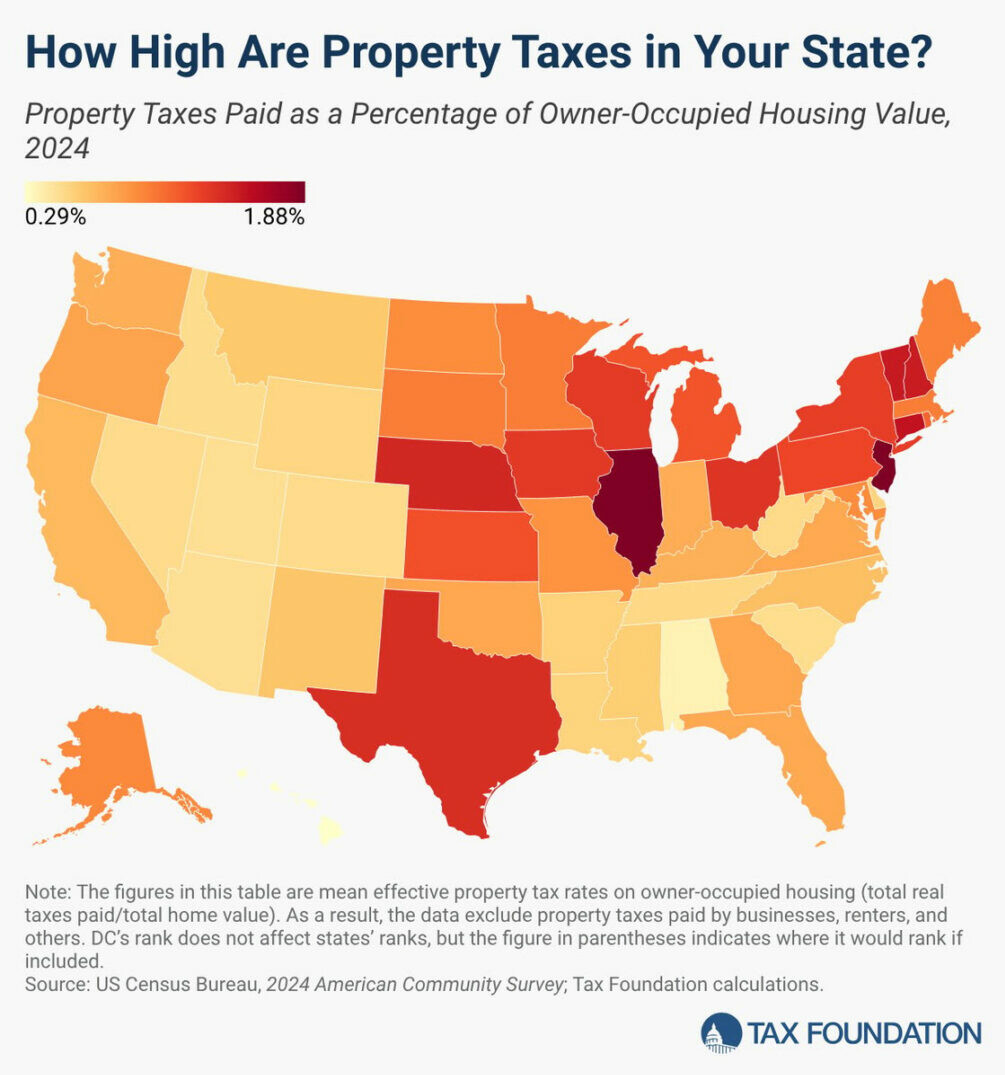
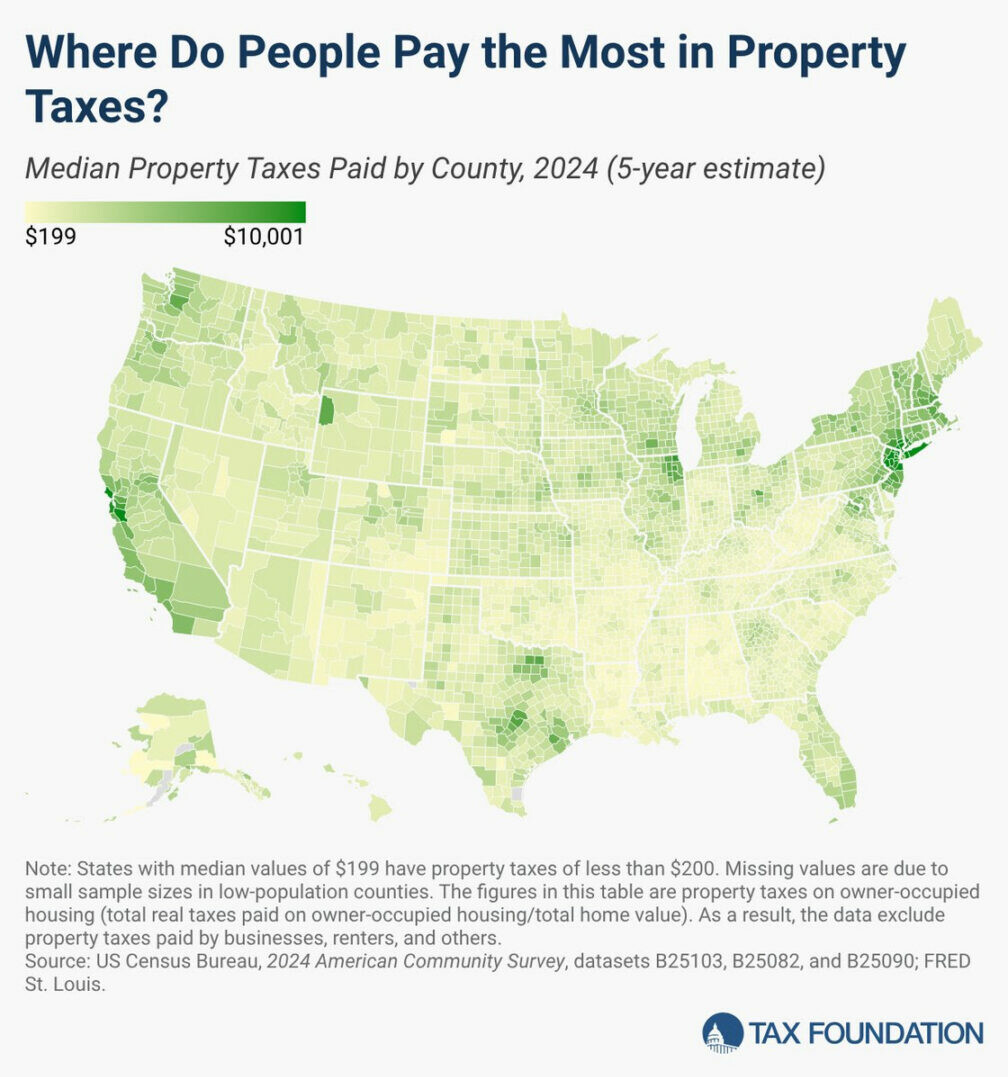
Zoom Out: Vermont has among the most expensive education systems in the country and some of the highest property taxes to pay for it, as shown by the Tax Foundation.
Healthcare Proposals Move Through Process
Just as with housing, the lack of affordability in healthcare permeates every problem the state faces. There are numerous bills targeted at different aspects of the issue.
The Senate Committee Passed Bills: The healthcare reform package moving through the State House is being framed as two-pronged: one bill (S.190) tackles what we pay for insurance, while the other changes how we pay for care (S.197).
- Capping Prices (S.190): This bill is a direct response to the high premiums faced by “small-group” plans (employers with fewer than 100 workers and municipalities). By capping hospital charges for these plans at a percentage of Medicare rates, the state aims to put “downward pressure” on the cost of care for the backbone of the local economy.
- Preventive Care “Pool” (S.197): This bill aims to shift primary care away from the “fee-for-service” model, with insurers paying into a collective pool that is distributed to providers as flat monthly payments.
- The Goal: Give doctors the flexibility to focus on keeping patients healthy rather than just billing for individual office visits.
House Committee Passed Bills: The House had numerous bills focused on a myriad of issues.
- Prescription Drug Discount Card (H.577): A new state-run partnership designed to save residents up to 80% on generic medications. This provides immediate “at-the-counter” relief for Vermonters struggling with rising drug costs.
- Association Health Plans (H.585): Part of the administration’s reform package, this includes a study on allowing small businesses to band together to form Association Health Plans (AHPs), which could potentially give them the same bargaining power as large corporations.
- Site Neutral Billing (H.585): An original proposal to make all outpatient services site-neutral, with a more targeted approach, with an equalized fee schedule for physical therapy, occupational therapy, and athletic training.
- Private Equity Guardrails (H.583): This bill targets the growing trend of corporate buyouts in healthcare. It would ban leveraged buyouts of providers and require strict ownership disclosures to ensure that patient care, not debt service, remains the priority.
- Public Oversight (H.585): This proposal adds public members to the BlueCross BlueShield board, a controversial move that drew sharp criticism from nonprofits outside of the healthcare sector.
Transportation: T-Bill Finds Limited Funding
While the education fund’s woes have been the subject of years of constraint, the transportation fund’s woes have been neglected for some time, and things are hitting a breaking point.
Catch up quick: The Vermont Transportation Fund is currently facing a structural deficit of $33 million as traditional revenue sources fail to keep pace with rising infrastructure costs.
- This shortfall is particularly critical because state funds are required to “match” federal dollars; failing to plug this $33 million gap could result in the loss of $163 million in federal highway aid.
- The Revenue Crisis: The deficit is driven by a widening gap between stagnant tax receipts and escalating expenses. Revenue from gas and diesel taxes has only grown 30% since 2000, while construction costs have tripled during the same period. Meanwhile, as vehicles become more fuel-efficient, they generate less tax revenue while continuing to cause wear and tear on roads.
- How bad could it get? The Agency of Transportation has warned that if funding is not addressed, the percentage of state pavement in “very poor condition” is projected to skyrocket from 6% today to 48% by 2035.
- Governor Scott’s Proposed Fixes: To balance the books, Governor Phil Scott has remained firmly opposed to a gas tax increase, instead proposing eliminating 31 positions within the Agency of Transportation and moving $10 million in motor vehicle Purchase and Use tax from the Education Fund to the Transportation Fund, specifically to secure federal matching funds.
The T-Bill: The omnibus transportation bill, or “T-Bill” was not the vehicle for much in the way of resolving transportation funding woes.
- The bill features Mileage-Based Fees: H.944 aims at addressing the decline in gas tax revenues by transitioning to Electric Vehicle (EV) owners from a flat registration surcharge to a Mileage-Based User Fee (MBUF).
- The Cost: The average driver is expected to pay between $150–$200 annually, charged $0.014 per mile for battery-electric vehicles. This is calibrated to match what a typical gas-powered car contributes to the state’s transportation fund via fuel taxes. If passed, the fee would take effect January 1, 2027.
- Juice worth the squeeze? The bill brings in very little in revenue with a high cost of compliance, and it is assessed retroactively at the time of registration, which is seeing increasing numbers of noncompliance.
Education Funding & Vehicle Taxes: the House Ways and Means Committee passed H.933 to redirect a larger portion of the Purchase and Use Tax (on vehicle sales) from the Education Fund to the Transportation Fund. To keep the Education Fund whole, the committee is looking at increasing the Meals and Rooms Tax allocation for education from 25% to 29%.
- This is a one-year change with the amount reverting next year.
Other Proposed Legislative Solutions: Legislators are exploring new ways to fund infrastructure at the local and state levels such as a secondary local option tax allowing towns to assess a second 1% local option tax on retail sales, rooms, meals, and alcohol specifically for transportation funding.
The Laundry List
Hundreds of hours of committee discussion each week culminate in our advocacy update, so not everything makes it into the overall update; however, we often cover what is left on the cutting-room floor here for our most dedicated readers.
- Read previous updates: Week 1, Week 2, Week 3, Week 4, Week 5, Week 6, Week 7, Week 8, and Week 9
- Road Rage in the LOT: This year’s T-Bill sought to use half of the surplus collected in the Payment in Lieu of Taxes Fund (PILOT) fund, which holds the state’s share of local options tax (LOT). In doing so, the Transportation Committee stumbled upon a secret agreement to direct PILOT surplus to cover reappraisal cost, upsetting many, as that activity is typically funded by the General Fund, and municipalities would like to see that surplus, which comes from their taxpayers, be directed to more efforts to alleviate transportation pressures for them.
- Retirement lists growing: Two chairs are not seeking re-election. Kathleen James of Manchester, who steers the House Committee on Energy and Technology, and Matt Birong, who steers the House Committee on Government Operations and Military Affairs, both officially announced this week that they will not seek re-election. A mass exodus is coming to cap off a biennium that saw an unprecedented eight mid-session retirements. Have any retirement or election scuttlebutt? We’d love to hear it.
- On March 16, Governor Scott signed H.516, An act relating to approval of amendments to the charter of the Town of Essex
- More childcare regulation: S.206 passed the Senate this week, requiring licensure of early childhood educators by the Office of Professional Regulation.
- Date privacy bill on the move: H.211 would add various statutory provisions to protect the personal information of the residents. It would also require data brokers to provide notice of security breaches, certify that the information they collect is used for legitimate purposes, and delete personal information upon request
- Weekend listening: It’s not every day that we suggest in this update that you listen to a podcast, much less an hour-long podcast; however, the recent interview of Senate Pro Tem Phil Baruth on 802 News with Mark Johnson is worth your time if you are interested in how the State House works, what the future might look like with the coming wave of retirements at the end of this session, and the broader education transformation push the Senator has been at the forefront on.