.png "Return Home")
Advocacy Update: Week 5 – 2026

Thank you to this week’s sponsor of our Advocacy Update:

February 6, 2026
Map Making Matters
If you love maps, this is the session for you. Two of the most difficult and consequential policy areas in Vermont involve mapping.
- As a state, we are transitioning our land-use policy, Act 250, to place-based jurisdiction, which necessitates mapping,
- As legislators seek efficiency, scale, and better outcomes, they seek to consolidate school districts and eventually schools, which also necessitates new maps.
Fewer people on the maps: Recent Census data revealed that Vermont had the largest population decline by percentage in the country last year, losing over 1,800 residents.
- This decline is driven by both an aging population (more deaths than births) and a second consecutive year of negative net migration, where more people moved away from Vermont than moved in.
- Economists warned that this trend exacerbates the state’s workforce shortage and tax base challenges, as one in three Vermonters will be over 65 in about three years.
Reality Check: These maps aren’t abstract exercises; they should be about dealing with this urgent demographic challenge.
- Our state has statutory housing goals that new place-based jurisdictional mapping should be helping, yet at this moment it looks like will encumber, and
- As our student population rapidly declines even faster than our overall population, consolidation is not only essential for better educational outcomes, efficiencies, and cost, it is more and more inevitable.
There is a lot in the Laundry List this week, in the launch of a $2 billion housing infrastructure program (CHIP), a potential forensic facility, and more.
We strive to make these concise and easy to read. Feedback is not just welcomed, it’s encouraged – advocacy@vermont.org
LCC Legislative Breakfast Series
Every year, we bring legislators, policymakers, and LCC members together to celebrate business ownership and entrepreneurship and advocate for economic opportunity for our region. Sponsored by EastRise Credit Union, our Legislative Breakfasts are opportunities to connect with legislators and those in higher office.
January Legislative Breakfast
- When: Working to Reschedule
- Where: The Nine | 1205 Airport Parkway, South Burlington
March Legislative Breakfast
- When: Monday, March 16 | 8:30 am
- Where: Dealer.com | 1 Howard Street, Burlington
Thank you to our hosts, The Nine and Dealer.com, for their generous support of our Legislative Breakfast Series!
Thank you to our breakfast sponsor.

Mapping Act 250 Changes
This week, legislative activity regarding Act 250 focused on the complex and controversial implementation of Act 181, the 2024 reform law that shifted jurisdiction from project size to a location-based “tiered” system.
- While the law aims to promote housing in town centers and protect sensitive ecosystems, it has sparked significant friction between state planners and rural advocates who see tighter restrictions on 60% or more of the state as a land grab.
- Additionally, critics from more urban areas of the state have noted that the 2% to 5% of the state greenlit for development is woefully inadequate to meet the state’s housing needs and statutory goals.
Catch up quick: Act 181 transitioned the state to place–based jurisdiction, shifting from how big a project is to where it is located, which means the state is currently undergoing a first-of-its-kind mapping process to categorize all Vermont land into three tiers, which will determine how Act 250 applies:
- Tier 1 Growth Areas: Designed to ease homebuilding, this tier is split into Tier 1A, which is fully exempt for towns with sophisticated zoning, and Tier 1B, which is exempt for projects of 50 units or fewer.
- Regional planners expect only about 2% to 2.5% of the state’s land to eventually fall into this category, though for Chittenden County, this could be as high as 11% of the land.
- Tier 2 Status Quo for Rural Areas … with a Significant Addition: Encompasses the majority of the state, where the existing Act 250 structure continues with the addition of the “road rule” under which constructing a private road over 800 feet long, or a combination of roads and driveways longer than 2,000 feet, triggers Act 250 jurisdiction in Tier 2 areas.
- Tier 3 “Critical Natural Resources”: Areas like headwater streams, rare natural communities, and habitat connectors where Act 250 review will be automatic for most construction.
Zoom out: This does not include what is in separately passed legislation, and this author jokingly calls “Tier 4”;
- Act 121, passed in 2024, authorizes the Department of Environmental Conservation to establish statewide permitting requirements for development within mapped river corridors, which will cover about 209,000 acres of Vermont land affecting an estimated 45,000 parcel owners.
Implementation Tensions: Members of the Rural Caucus have expressed frustration, worrying that this new regulatory regime could freeze economic growth in small towns. Legislators argued that the “sequencing” of the law is flawed, as regulatory triggers (like the road rule) are scheduled to take effect before the regional maps that define the tiers are finalized.
Legislative Action: H.730
In response to these concerns, H.730 was introduced by Representative Laura Sibilia and a large coalition of rural lawmakers to slow down implementation. Key provisions of the bill include:
- Delayed Rulemaking: Moving the final Tier 3 rulemaking deadline from 2026 to February 1, 2027.
- Property Owner Notice: Requiring the Land Use Review Board (LURB) to mail written notice to every property owner in a Tier 2 or Tier 3 area at least 30 days before public meetings.
- Tax Valuation Adjustments: Requiring municipal assessors to account for any impact on fair market value caused by Act 250 development requirements when appraising parcels.
S.305: Additionally, Senator Kesha Ram Hinsdale introduced S.305 to clarify the law’s intent, noting in a recent meeting that current density rules may unintentionally encourage large, expensive housing instead of the clustered affordable or senior housing the legislature intended.
Between the lines: we’ve discussed in past updates the potential perils of locking up more land in regulation and the effects this will have on the state’s tax base, which is showing signs of distress with delinquencies.
Read more about Act 181 implementation via VPR
Education: Mapping & Stabilization Conversations Get Real
Some of the more abstract debates gave way to concrete proposals this week as;
- The House Education Committee considered a new map for educational governance,
- The Senate inched toward approving allowable growth rates for fiscal stabilization, and
- The House Ways and Means Committee began discussing the possible uses of surplus funds for the annual property tax rate-setting bill, called the yield bill.
Mapping in the House
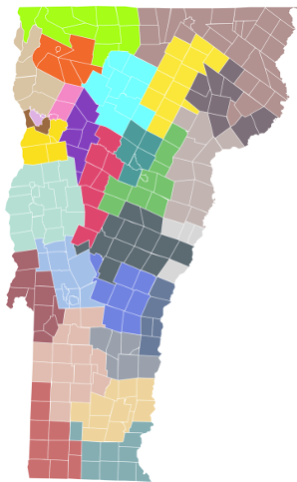
House Education introduced a draft map to consolidate Vermont’s 119 school districts into 27 supervisory districts.
- Target Size: The districts are designed to serve between 2,000 and 4,000 students based on academic research brought to the Committee, suggesting it is the optimal size for administrative capacity and scale.
- Administrative Shift: The proposal would eliminate supervisory unions and non-operating districts in favor of unified supervisory districts. The Chair emphasized that this is a governance change, not a directive on school closures or student assignments, though members noted that larger boards might eventually make such decisions.
Senate Edges Forward on Education Fiscal Stabilization
The Senate Finance Committee continued work on S.220, a bill intended to act as a two-year “bridge” to limit education spending growth for FY 28 and FY 29.
Catch up quick: The bill proposes graduated caps ranging from 2% for the highest-spending districts to 9% for the lowest-spending districts.
To ensure the bill remains constitutional under the Brigham v. State decision, the committee has reached a consensus on including a formal appeals process to allow for schools to bring forth.
- Uncontrollable costs: School boards would be able to petition the Secretary of Education to exceed the cap if they face “extraordinary or uncontrollable” events.
- Qualifying events: These may include emergency facility failures, sudden enrollment shifts, data errors, or expensive residential placements for students with intensive needs.
Ways and Means Committee Discusses the Ways to Use Surpluses and What it Means
House Ways and Means is exploring how to use a one-time $105 million general fund transfer to buy down property tax rates as part of the annual “yield bill” which sets property tax rates. Scenarios include,
- Help everyone this year: a uniform buy-down across all classes, lowering the average bill increase to ~5.8%,
- Help only homeowners this year: a homestead-only buy-down that would increase property taxes for businesses, or
- Help no one this year, and hedge for the future: placing funds into a reserve to avoid a “cliff” in future years and allowing an increase this year.
The Laundry List
Hundreds of hours of committee discussion each week culminate in our advocacy update, so not everything makes it into the overall update; however, we often cover what is left on the cutting-room floor here for our most dedicated readers.
- Read previous updates: Week 1, Week 2, Week 3, and Week 4
- Secure Mental Health Facilities: The Senate Judiciary Committee reviewed S.193, a proposal to create a secure forensic facility within the Department of Corrections (DOC) to provide a clinical pathway for the small number of defendants charged with serious violent crimes who are incompetent to stand trial but do not fit in civil psychiatric hospitals.
- Noncompete Agreements: The House Commerce Committee is continuing to refine H.205, which would largely ban noncompete agreements, with narrow exceptions for senior executives earning over $161,000 and certain startup employees.
- CHIP LAUNCHED! Governor Phil Scott and the Agency of Commerce and Community Development announced this week that the application portal for the new Community and Housing Infrastructure Program (CHIP) is now open! This project-based tax increment financing (TIF) tool represents one of the largest investments in municipal infrastructure in Vermont history, with the potential to invest $2 billion between now and 2035.
- Prescription Drug Discount Card: The House Health Care Committee unanimously approved H.577, creating a state drug discount card program with other states utilizing third-party assistance and coupons that count toward a patient’s insurance deductible.
- Data Center Regulation: H.727 was introduced to manage the potential arrival of large-scale, AI-driven data centers. The bill would create a separate utility rate class to ensure these high-load facilities—which can consume as much water as 15,000 homes—pay for their own infrastructure upgrades rather than shifting costs to residents.
- All Aboard! Amtrak is planning to roll out new Airo trains in Vermont by 2029, which could save 20–25 minutes per trip by eliminating the need to switch from diesel to electric locomotives in Connecticut. The Legislative Transportation Committees are expected to send a letter of support.
- Junk food ban: Vermont could soon join 18 other states in banning people from using the Supplemental Nutrition Assistance Program (SNAP), known as 3SquaresVT, to purchase products that the state deems unhealthy. Read more via SevenDays
- Clean Heat Case Closes: While it remains a priority in Vermont’s Climate Action Plan, the Vermont Public Utility Commission (PUC) has officially declared “case closed” when it comes to Clean Heat Standard, halting the process after concluding it lacked clear legislative authority to implement the regulation.
- Budget Hearings: The Vermont House and Senate Committees on Appropriations will hold two joint public hearings on Thursday, February 12, 2026, at 1:45 p.m. and Thursday, February 19, 2026, at 5:00 p.m. via in person or video conference. Anyone interested in testifying should sign up in advance of the hearing through the following online form not later than 10:00 a.m. on February 12, 2026.
- Inspecting the Impact of Inspections: The Senate Transportation Committee discussed S.211, which would allow for biennial (every two years for those who get tripped up on that) car inspections instead of annual ones to reduce the financial burden on low-income Vermonters.
Hey! You read the whole update. You probably have some thoughts on the content or how we delivered it. Feel free to reach out with those at advocacy@vermont.org.